
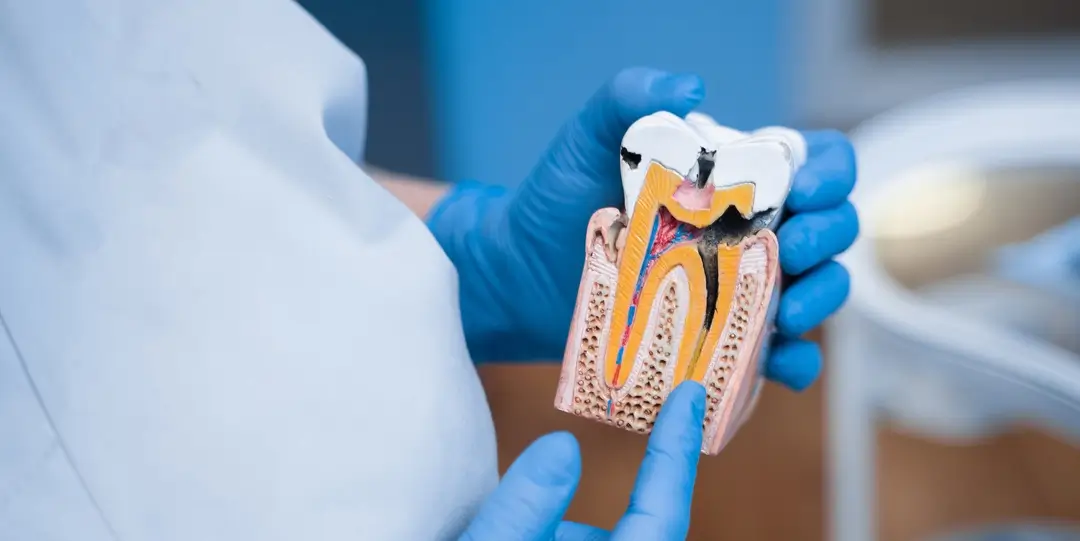


Root Canal Cost Explained: With and Without Insurance (2026 Guide)
A root canal is one of those dental procedures that immediately triggers anxiety—not just about the procedure itself, but about the cost. How much is a root canal? and Does insurance cover it? are usually the first two questions patients ask.
The good news: root canals are far more affordable than implants, and insurance actually covers a decent portion of them. The bad news: the total cost can still be significant, and there are variables that change the price dramatically.
This guide breaks down exactly what root canals cost in 2026, what insurance typically covers, and how to find transparent pricing from qualified dentists.
How Much Is a Root Canal? The Real Numbers
The average cost of a root canal ranges from $700 to $2,000 per tooth, depending on which tooth and how complex the case is.
Here’s the breakdown:
Front teeth (incisors & canines): $700-$1,200 Front teeth have simpler anatomy with typically one root canal. These are the cheapest root canals.
Premolars: $900-$1,500 Premolars can have one or two root canals, making them moderately complex.
Molars: $1,200-$2,000 Molars typically have two to three root canals, making them the most expensive. Upper molars are often pricier than lower molars because they’re harder to access.
These prices are national averages and don’t include:
- The crown that often follows a root canal (usually $800-$2,000 additional)
- Any preparatory work
- Anesthesia or sedation
- Post-op medications
So the real total cost for a tooth that needs a root canal AND a crown is typically $1,500-$4,000 per tooth.
What Affects Root Canal Cost?
Not all root canals are created equal. Several factors change the price significantly:
1. Tooth Location & Complexity
As mentioned, front teeth are cheaper, molars are more expensive. But within each category, complexity matters:
Straightforward case: One clear root canal, no complications = lower cost Complex case: Calcified canals, curved roots, previous treatment attempts = higher cost
Your dentist can usually estimate complexity from X-rays before starting. If they find complications during treatment, costs can increase.
2. General Dentist vs. Endodontist

A general dentist typically charges $700-$1,500 for root canals.
An endodontist (specialist in root canals) typically charges $1,000-$2,000+ for the same procedure.
Why the difference?
- Endodontists have advanced training and equipment
- Endodontists see more complex cases
- Specialists often take cases general dentists refer because they’re too difficult
When should you see an endodontist?
- Your tooth has calcified canals
- You’ve had previous root canal treatment that failed
- Your tooth has unusual anatomy
- Your case is complex
When a general dentist is fine:
- Straightforward root canal, first time
- Standard anatomy
- No previous treatment failures
Many general dentists handle root canals routinely and do excellent work. It’s not always necessary to see a specialist unless there’s complexity.
3. Cone Beam CT (CBCT) Imaging
Some dentists use advanced 3D imaging (CBCT scans) to plan root canals, especially complex cases. This adds $200-$500 to the cost.
Standard 2D X-rays are included in most root canal pricing. CBCT is optional but can help with difficult cases.
4. Retreatment vs. Initial Treatment
If you’re having a root canal retreated (because the first one failed or needs redoing), expect to pay 25-50% more.
Retreatment is more difficult because:
- Previous filling material has to be carefully removed
- Anatomy is more challenging to navigate
- Time required is longer
5. Tooth Type (Natural vs. Already Treated)
A natural tooth that’s never been treated is usually cheaper than:
- A tooth with a previous crown (crown has to be removed and replaced)
- A tooth that had a failed previous root canal
- A tooth with posts or other internal structures
6. Geographic Location

Major cities: Root canals tend to cost more ($1,200-$2,000+) Suburban areas: Mid-range pricing ($900-$1,600) Rural areas: Sometimes lower pricing ($700-$1,200)
This follows general cost-of-living patterns. A specialist in Manhattan will charge more than one in rural Vermont.
7. Sedation Options
Most root canals are done with local anesthesia (numbing). If you want nitrous oxide (laughing gas) or IV sedation, add:
Nitrous oxide: $75-$150 IV sedation: $300-$800
These are optional but help with dental anxiety.
What Does Insurance Cover for Root Canals?
This is where root canals are actually better positioned than implants. Most dental insurance covers root canals at a reasonable rate.
Standard Coverage Levels
Typical insurance coverage for root canals: 50-80% (after your deductible)
This puts them in the “major restorative” category, which is better covered than cosmetic work but not as well as preventive care.
Preventive (cleanings, exams): 90-100% covered (before deductible in most plans) Basic restorative (fillings, extractions): 70-80% covered Major restorative (root canals, crowns): 50% covered Orthodontics/Cosmetic: 0-25% or not covered
Here’s how this works in practice:
Let’s say your plan covers 50% of major restorative work, your deductible is $1,000/year, and your annual maximum is $2,000.
- Root canal cost: $1,200
- Your deductible: $1,000
- Insurance pays: $0 (you haven’t met deductible yet)
- You pay: $1,200
Then if you need a crown after ($1,200):
- Crown cost: $1,200
- Deductible already met: $0
- Insurance pays 50%: $600
- Annual maximum used so far: $1,000 (from the root canal, once deductible was met) + $600 (crown) = $1,600
- You pay: $600
This is simplified, but the point is: your insurance will likely pay something, but not everything, and deductibles and annual maximums matter a lot.
Important Coverage Details
What insurance typically covers:
- Endodontic treatment (the actual root canal procedure)
- Local anesthesia
- Standard imaging (X-rays)
- Basic follow-up care
What insurance typically doesn’t cover:
- The crown that follows (sometimes covered as a separate procedure under crown coverage)
- Nitrous oxide or IV sedation
- CBCT advanced imaging (sometimes)
- Specialized treatment approaches
- Complications or retreatment (sometimes, depending on plan)
Special situation: Do I need a crown after a root canal?
Not always, but usually. About 90% of root canal teeth need a crown within a few years because the tooth becomes brittle without its nerve and can crack.
Insurance typically covers the crown separately under crown coverage (usually 50% of the cost).
Root Canal Insurance Coverage by Plan Type
Traditional Dental Insurance (PPO/HMO)
Coverage: 50-80% of root canal cost (major restorative category)
This is the most common insurance type, and it covers root canals reasonably well. The main limitation is deductibles and annual maximums.
Example:
- Root canal: $1,200
- Your deductible: $1,000
- You pay the full $1,000 deductible
- Insurance pays 50% of remaining $200 = $100
- You pay $1,100 out of pocket
What to do: Check your plan for major restorative coverage percentage and ask about your deductible and annual maximum.
HMO Plans
Coverage: Often 50-80%, but with restrictions
HMO plans usually cover root canals, but with requirements:
- You must see an in-network provider (out-of-network costs more or aren’t covered)
- You might need a referral from your primary care dentist to see an endodontist
- Coverage can be more restrictive than PPO plans
What to do: Check your HMO’s provider directory and verify the dentist is in-network before scheduling.
Employer-Sponsored Plans
Coverage: Usually 50-80% for major restorative
Many employer plans are standard PPO plans with typical root canal coverage. Some larger employers offer better coverage (75-80% for major work).
What to do: Check your benefits documentation or call HR/benefits.
Medicare
Coverage: 0% for root canals (dental not covered)
Original Medicare doesn’t cover dental work, including root canals. Some Medicare Advantage plans include dental benefits, but they often don’t cover root canals (focusing on preventive care and basic restoration up to annual maximums of $1,000-$2,000).
What to do: Don’t expect Medicare coverage. Look into dental discount plans or state-specific programs.
Medicaid
Coverage: Varies by state, 0-100%
Medicaid coverage for root canals varies dramatically:
- Some states cover them fully (rare)
- Some states cover them at 50-80% (more common)
- Some states don’t cover them at all
What to do: Contact your state’s Medicaid program and ask about endodontic (root canal) coverage.
Dental Discount Plans
Coverage: 10-20% discount (not insurance)
Dental discount memberships offer discounts through network dentists. Instead of paying full price, you might pay 80-90% of the discounted rate.
Example: Root canal normally $1,200, discounted rate $1,000, you pay $800-$900.
What to do: If uninsured or your insurance doesn’t cover root canals well, a discount plan ($40-$200/year) might be worthwhile.
Root Canal Cost: Real Examples
Here’s what actual patients paid (averages from 2026 data):
Scenario 1: Incisor Root Canal, In-Network, Good Coverage
- Root canal cost: $900
- Insurance coverage (50% after deductible met): $450
- Patient pays: $450 out of pocket
Scenario 2: Molar Root Canal, Complex Case, In-Network
- Root canal cost: $1,800
- Deductible: $1,000
- Insurance coverage (50% of remaining): $400
- Patient pays: $1,400 out of pocket (full $1,000 deductible + 50% of remaining)
Scenario 3: Molar Root Canal, In-Network, Plus Crown
- Root canal: $1,600
- Crown: $1,400
- Total: $3,000
- Deductible ($1,000) applied to root canal
- Insurance covers 50% of both after deductible
- Insurance pays: $1,000 (after deductible, 50% of $2,000)
- Patient pays: $2,000 out of pocket
Scenario 4: Out-of-Network Root Canal
- Root canal: $1,500
- Insurance covers in-network at 50%, but out-of-network at 20%
- Insurance pays: $300 (20% of $1,500)
- Patient pays: $1,200 out of pocket
This is why staying in-network matters.
Does Insurance Cover Root Canals? Full Answer
Yes, most dental insurance covers root canals at 50-80% in the major restorative category.
But “covers” doesn’t mean “pays for all of it.” Your actual out-of-pocket cost depends on:
- Whether the dentist is in-network
- Your deductible and whether it’s been met
- Your annual maximum and how much you’ve used
- Your plan’s specific coverage percentage for major restorative work
- Whether complications require retreatment
The best way to know: Get a pre-authorization from your insurance before the procedure.
Getting Pre-Authorization for Root Canals
Just like with other dental work, getting pre-authorization tells you exactly what your insurance will pay.
Step 1: Dentist provides treatment plan
Your dentist submits:
- Description of the root canal (tooth number, complexity)
- Reason (pain, infection, etc.)
- Specific code (D3110 for endodontic therapy)
- Cost breakdown
Step 2: Submit to insurance
The dentist (or you) submits to insurance with a pre-authorization request.
Step 3: Insurance responds
They’ll tell you:
- Whether the procedure is covered
- Coverage percentage
- What your deductible and maximum are
- Your expected patient responsibility
Step 4: Proceed with confidence
You know exactly what you’ll pay before you start treatment.
Important: Pre-authorization isn’t a guarantee (insurance can still deny after the fact), but it’s the best information available beforehand.
How Much Will You Pay Out of Pocket for Root Canals?
After insurance, most patients pay $400-$1,200 out of pocket for a single root canal, depending on their coverage.
If a crown is needed after, add another $400-$1,000 out of pocket (depending on crown coverage).
Total out-of-pocket for root canal + crown: $800-$2,200 for most patients.
This can be reduced through:
1. FSA or HSA
Set aside pre-tax money for dental work. Reduces your out-of-pocket by your tax bracket percentage (15-37%).
Example: $1,200 root canal, 25% tax bracket, saves $300.
2. Payment Plans
Most dentists offer payment plans (0% interest for 12-24 months) that spread the cost over time.
3. Dental Discount Memberships
10-20% off through discount plans. Not insurance, but saves money if uninsured.
4. Dental Schools
University dental schools sometimes perform root canals at 40-50% off pricing. Takes longer but costs much less.
5. Negotiate With Your Dentist
Ask about:
- Bundled pricing (if multiple procedures needed)
- Cash discounts (10-15% for upfront payment)
- Family/referral discounts
Finding Dentists With Transparent Root Canal Pricing
Not all dentists are upfront about costs. Here’s what to look for:
Red flags:
- Won’t quote a price until they see you
- Quote changes significantly after the visit
- Staff can’t explain what insurance covers
- Pressure to proceed without pre-authorization
Green flags:
- Provides written estimate before treatment
- Submits pre-authorization to insurance
- Clear breakdown of costs
- Staff can explain coverage and your out-of-pocket responsibility
- Offers payment plan options
- Transparent about whether they refer complex cases or handle them themselves
For root canals specifically, ask:
- “Are you a general dentist or endodontist performing this?” (Helps assess expertise)
- “Will you submit pre-authorization to my insurance?” (Critical for knowing your costs)
- “What’s your estimated cost breakdown?” (You want itemized, not just a total)
- “What if the case is more complex than expected?” (How are cost increases handled)
- “Do you have payment plan options?” (Helps with affordability)
- “What happens if the root canal fails?” (Do they retreat it, at what cost?)
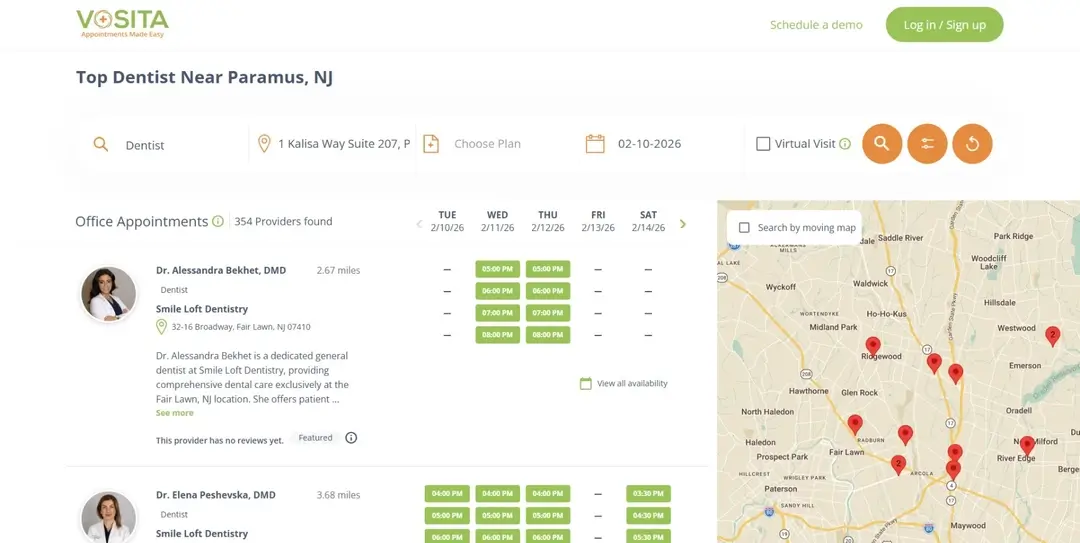
Using Vosita to Find Dentists for Root Canals
Finding a dentist who’s transparent about costs and accepts your insurance shouldn’t be difficult, but it often is.
- Filtering by insurance acceptance – Only see dentists who accept your plan, no guessing
- Transparent pricing information – Dentists on the platform commit to transparent pricing practices
- Real availability – See actual open appointments instead of playing phone tag
- Verified patient reviews – Read reviews from real patients about their root canal experience, cost transparency, and insurance handling
- Direct booking – Schedule your consultation immediately instead of waiting for callback
- Dentist profiles – See credentials, qualifications, and experience with endodontic treatment
Instead of calling five offices and explaining your situation each time, you browse dentists who accept your insurance, read what other patients paid and experienced, and book directly.
This is especially important for root canals because you need to confirm the dentist can handle your specific case and that you understand the cost upfront.
Root Canal Cost: Key Takeaways
- Average cost: $700-$2,000 per tooth depending on tooth location and complexity
- Insurance covers root canals better than implants – typically 50-80% in the major restorative category
- Your out-of-pocket cost depends on deductible, annual max, and coverage percentage – can range from $400-$1,200
- Front teeth are cheaper, molars are more expensive – anatomy matters
- A crown often follows root canal and adds $800-$2,000 to total cost (covered separately under crown coverage)
- Pre-authorization is essential – tells you exactly what insurance will pay before you start
- You have cost-reduction options – payment plans, FSA/HSA, discount plans, dental schools
- Find a transparent dentist who submits pre-authorizations – this saves time, stress, and surprises
- General dentists can perform root canals well – specialist endodontists are worth it for complex cases
- In-network providers cost significantly less – make sure your dentist is in your insurance network
The key is finding a dentist who’s upfront about costs and helps navigate your insurance before treatment starts. That’s how you avoid surprises and get quality care at a price you understand.
FAQ: Root Canal Cost
How much does a root canal cost without insurance? Without insurance, root canals typically cost $700-$2,000 per tooth depending on tooth location and complexity. Front teeth are cheaper ($700-$1,200), molars are more expensive ($1,200-$2,000). Additional costs include crown ($800-$2,000), sedation ($75-$800), and advanced imaging ($200-$500).
What’s the average cost of a root canal? The average root canal costs $1,200-$1,500 nationally. However, this varies significantly by tooth location (front teeth cheaper, molars more expensive), geographic location (major cities cost more), and dentist type (general dentists less expensive than specialists, unless complexity justifies specialist care).
Does insurance cover root canals? Yes, most dental insurance covers root canals at 50-80% under the major restorative category. However, coverage depends on whether the dentist is in-network, whether you’ve met your deductible, your annual maximum, and your specific plan’s coverage percentage. Get pre-authorization from your insurance before the procedure to know your exact coverage.
How much does insurance pay for a root canal? Insurance typically pays 50% of root canal cost after your deductible is met (for major restorative work). Some plans pay up to 80%. However, if you haven’t met your annual deductible, you pay the full amount until the deductible is satisfied. Check your plan’s coverage percentage and call your insurance for a pre-authorization to know your specific payment.
What’s the out-of-pocket cost for a root canal? After insurance, most patients pay $400-$1,200 out of pocket for a root canal. This varies based on your specific plan’s deductible, coverage percentage, annual maximum, and whether the dentist is in-network. Front teeth cost less out-of-pocket, molars cost more.
Do I need a crown after a root canal? About 90% of root canal teeth need a crown within a few years. Without a crown, the tooth becomes brittle and can crack or fail. Insurance usually covers the crown separately under crown coverage (typically 50% after deductible). Total out-of-pocket for root canal + crown is typically $800-$2,200.
Why is a molar root canal more expensive than a front tooth? Molars have two to three root canals, while front teeth have one. Multiple canals require more time, specialized equipment, and skill. Molars are also harder to access and more difficult to treat, making them more complex and expensive.
Should I see a general dentist or endodontist for a root canal? For straightforward root canals on front teeth or premolars, a general dentist is fine and costs less ($700-$1,500). For complex cases (calcified canals, failed previous treatments, unusual anatomy), an endodontist specialist ($1,000-$2,000+) is worth the cost due to their expertise and equipment.
Can I get a root canal on a payment plan? Yes, most dentists offer payment plans with 0% interest for 12-24 months, making the cost spread over time instead of paying all upfront. Some practices also offer 10-15% discounts for full cash payment upfront.
What’s a pre-authorization for root canal treatment? Pre-authorization is a request your dentist submits to your insurance asking them to confirm what they’ll cover for your specific root canal. Insurance responds with the coverage percentage, your deductible status, annual maximum used, and your expected out-of-pocket cost. Always get pre-authorization before starting treatment so there are no surprises about cost.
Does Medicare cover root canals? No. Original Medicare does not cover dental work, including root canals. Some Medicare Advantage plans include dental benefits, but they rarely cover root canals, focusing instead on preventive care and basic procedures up to annual maximums of $1,000-$2,000. Seniors should not expect coverage.
What if my dentist says the root canal is more complex than expected? If complications arise (calcified canals, curved roots, etc.), treatment time and cost may increase. This is why pre-authorization is important—it tells you the estimated cost. If complexity increases significantly, ask your dentist for a revised estimate before continuing. Some patients choose to get referred to an endodontist for complex cases.
Meta Description (160 characters): How much is a root canal? Costs range $700-$2,000. Learn insurance coverage, out-of-pocket costs, and how to find transparent dentist pricing on Vosita.
EO Focus: Primary keyword “how much is a root canal” + supporting keywords naturally integrated
SEO Tips from Shehryar:
- Add interlinks to the previous dental articles
- Add FAQs schema
- Add Article/Blog schema
We have to install RankMath. I will do it and then I will show you how we can add FAQs schema.